
Bitcoin did not suddenly appear in 2009. It is the result of several decades of research in cryptography, distributed computing, and monetary theory.
Its creation is part of a broader intellectual and technological movement: the cypherpunks, who sought to use cryptography to protect privacy and create financial systems independent from governments.

The Cypherpunk movement emerged in the late 1980s. It brought together cryptographers, programmers, and libertarian activists who believed that cryptography is a tool of freedom.
In 1993, Eric Hughes published the Cypherpunk Manifesto, stating that privacy is essential in the digital age.
The cypherpunks exchanged their ideas through a famous mailing list, where projects for independent and censorship-resistant digital currencies circulated.
Creating a digital currency raises a major problem: double spending. Unlike a physical banknote, a digital file can be copied infinitely.
How can a user be prevented from spending the same unit twice without a central authority?
Before Bitcoin, the usual solution was to use a central verification server. This introduced a point of control and vulnerability.
Creating a digital currency raises a major problem: double spending. Unlike a physical banknote, a digital file can be copied infinitely.
How can a user be prevented from spending the same unit twice without a central authority?
Before Bitcoin, the usual solution was to use a central verification server. This introduced a point of control and vulnerability.
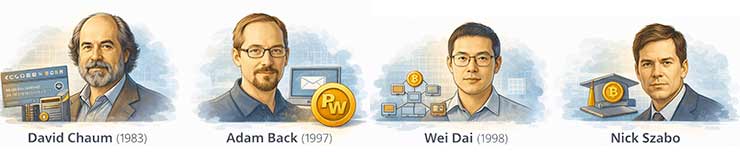
Several attempts preceded Bitcoin:
Each of these projects contributed an essential piece of the puzzle, but none fully solved the double-spending problem without a central authority.
On October 31, 2008, a person (or group) using the pseudonym Satoshi Nakamoto published a nine-page document titled:
"Bitcoin: A Peer-to-Peer Electronic Cash System"
This document proposes an elegant solution combining:
The white paper can be viewed here:
https://bitcoin.org/bitcoin.pdf
On January 3, 2009, Satoshi Nakamoto mined the first Bitcoin block, known as the Genesis block.
He inserted a symbolic message taken from the British newspaper The Times:
"The Times 03/Jan/2009 Chancellor on brink of second bailout for banks"
This message is often interpreted as a criticism of the banking system and the bailout of banks after the 2008 financial crisis.
The Bitcoin network then became operational.
The identity of Satoshi Nakamoto remains unknown. Despite many speculations, no formal proof has ever identified the creator of Bitcoin.
Satoshi actively participated in the development of the project until 2010, then gradually disappeared, leaving the community to continue its development.
It is estimated that Satoshi owns around one million bitcoins, which have never been moved.
This voluntary disappearance reinforces the decentralized and neutral nature of the project.
Bitcoin is not an isolated invention, but the culmination of decades of research in cryptography, distributed systems, and monetary theory.
It combines earlier ideas with a major innovation: the use of proof of work and economic incentives to create decentralized consensus without a central authority.
The history of Bitcoin is the story of a technological and philosophical convergence that has transformed the way the world thinks about money.