
Bitcoin is a global digital currency, designed to operate without a bank or central authority. Its supply is strictly limited to 21 million units, making it a naturally scarce asset.
Transactions are recorded on a public blockchain, verifiable by anyone and impossible to modify once validated. Thanks to its decentralized architecture, Bitcoin enables direct exchanges between individuals, without intermediaries and without borders.
Secured by proof of work and divisible up to the eighth decimal place (the satoshi), Bitcoin represents a transparent, pseudonymous, and globally accessible monetary infrastructure.
Bitcoin is an open-source protocol operated by a global network of independent computers. No bank, company, or government controls its issuance, its rules, or its transactions. This absence of a central authority gives it a level of neutrality unprecedented in monetary history.
Unlike traditional currencies, whose creation depends on political and economic decisions, Bitcoin is based on stable mathematical rules that are identical for everyone.
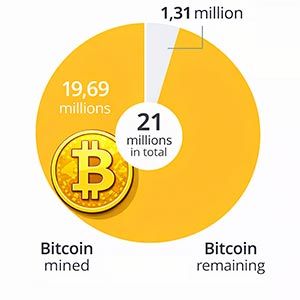
The maximum number of bitcoins is written into the code: 21 million, not one more. Around 19 million have already been issued. The remainder will be distributed gradually until around the year 2140.
However, the theoretical supply does not always reflect the supply actually available: some bitcoins are lost (misplaced keys), while others are held for the long term. This effective scarcity strengthens the idea of Bitcoin as digital gold.
Bitcoin has a predictable monetary policy: the creation of new bitcoins decreases over time. Approximately every four years, an event called the halving cuts the miners’ reward in half.
This mechanism gradually reduces Bitcoin’s inflation rate toward zero, which distinguishes Bitcoin from fiat currencies whose supply can increase without limit.
The proof of work is the mechanism that allows Bitcoin to remain secure without a central authority. It relies on a cryptographic computation that is costly to produce but easy to verify.
This expenditure of resources makes any attempt to falsify the history of transactions extremely difficult. Proof of work converts energy into economic security.
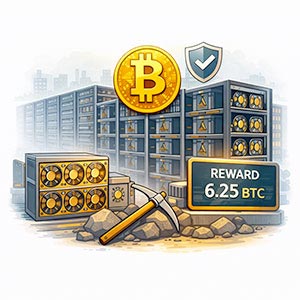
Miners provide their computing power to secure the network. They group transactions, create blocks, and follow the rules of the protocol.
In return, they receive a reward (new bitcoins) and transaction fees. Miners do not control Bitcoin: they are incentivized to act honestly because cheating would be costly and unprofitable.
These properties explain why Bitcoin is often presented as a major monetary innovation, both technological and economic.
Beyond its role as a store of value, Bitcoin can serve as a tool for transferring funds in regions where the banking system is unstable or censored. It can also be used for data timestamping by recording immutable proof in the blockchain.
Bitcoin also serves as the foundation for solutions such as the Lightning Network, which enables near-instant and low-cost payments, opening the door to new everyday uses.
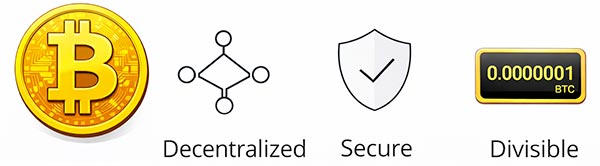
Bitcoin combines programmed scarcity, cryptographic security, political neutrality, and global accessibility. It represents the first decentralized digital currency operating without intermediaries.
Understanding what Bitcoin is means understanding the emergence of a new monetary paradigm: a system where the rules are public, predictable, and identical for everyone.